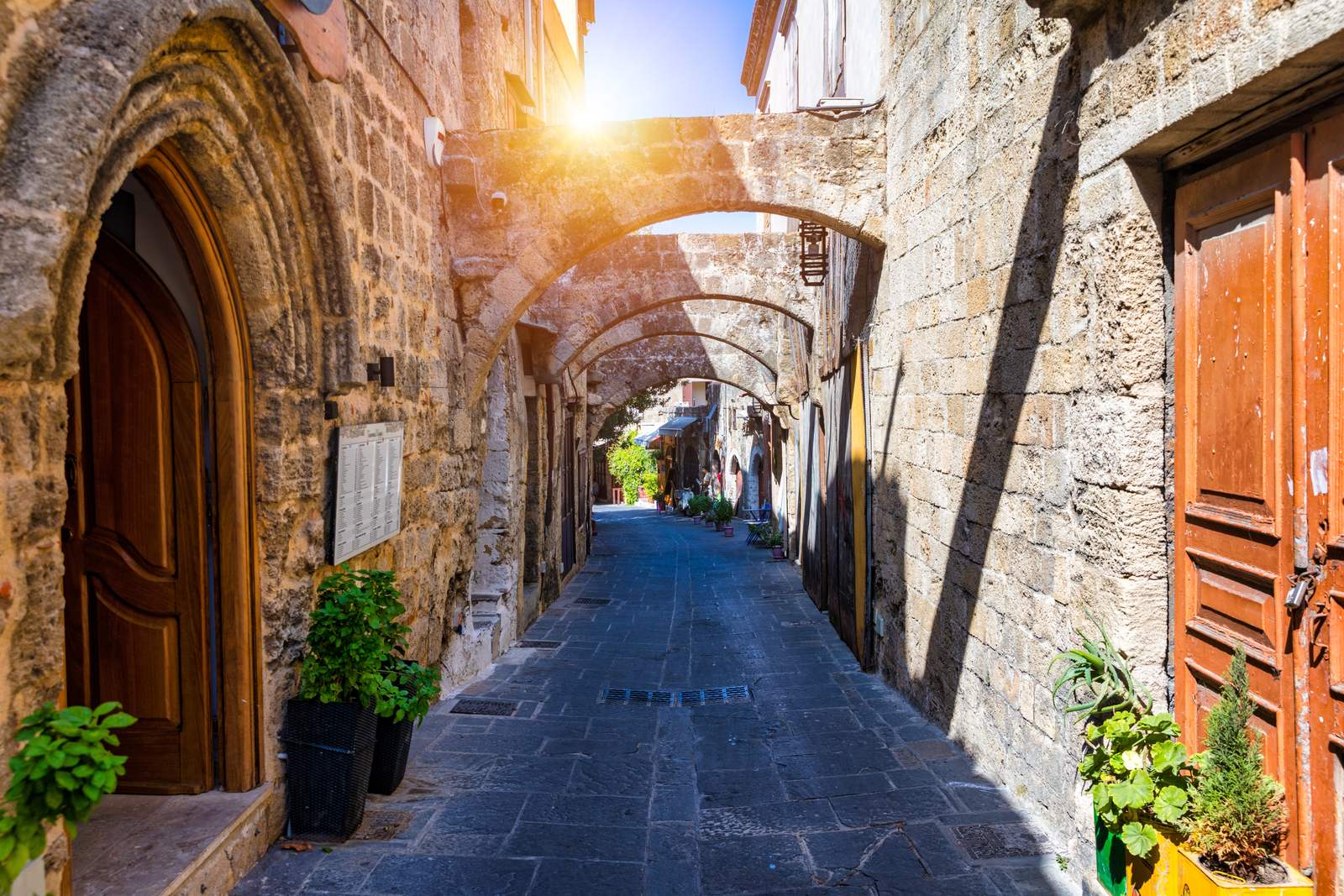

There's a moment that every low season traveller knows. Ours came in Rhodes Old Town, early one April. In summer, those medieval lanes are rammed with tourists and cruise ship passengers moving shoulder to shoulder. That morning they were calm, peaceful, serene and just wonderful, and there was time to talk. We fell into conversation with Savvas, a shoemaker whose family have been cobblers for generations, about his craft and his love of traditional Greek music. Then he disappeared into the back of his shop and came out with his beloved bouzouki to play Zorba the Greek for us. Afterwards he told us why he loves the low season: it gives him time to engage with travellers in a deeper way that simply isn't possible in the busy summer months.
Standing in that quiet lane, listening to a shoemaker play, we knew this was a better form of tourism. That moment is what this guide is about.
Low Season Traveller created the low season travel category. Since 2018 we've been the world's first multimedia platform dedicated entirely to low season travel, with destination guides covering more than 140 places, two podcasts, a magazine and a growing community of travellers who've discovered that the best time to visit almost anywhere is rarely the time everyone else goes. This guide brings together everything we've learned. Read it once and you'll understand why low season travel works. Keep it to hand and you'll know how to do it well, anywhere, for the rest of your travelling life.
What is low season travel?
Low season travel means visiting a destination during the months when it receives the fewest visitors. Every destination on earth has a low season, shaped by school holidays, weather patterns and habit, and travelling during it means experiencing a place at its calmest, most local and most authentic, usually with better value as a welcome side effect.
That's the definition. The practice is richer than the definition suggests.
Tourism in most destinations follows a steep annual curve. A short peak season absorbs a huge share of the year's visitors. Either side of the peak sit the shoulder seasons, the transitional months when crowds thin and prices soften. And then there's the low season, the stretch of the year when the tour groups are gone, the queues have evaporated and the destination belongs, once again, to the people who live there.
Peak seasons exist for understandable reasons. School calendars lock families into the same few weeks. Marketing reinforces the same postcard images taken in the same months. Habit does the rest. But the travel industry rarely puts it this plainly: the peak months aren't when a destination is at its best. They're simply when it's at its busiest. Those are very different things.
A quick word on the words we use
You may know this style of travel by other names. People search for "off season" and "off-peak", so it's worth saying where we stand, because these words shape how people see the quieter months more than you'd think.
We never say "off season", and the reason matters. "Off" suggests a season that has shut down, a light switched off, a destination in hibernation waiting for real life to resume. That's not what these months are. The museums are open, the restaurants are cooking for locals rather than coach parties, the festivals nobody markets abroad are in full swing, and daily life is running at its natural rhythm. These months aren't off. They're very much on, and often they're ripe.
"Off-peak" is a fairer term, and one we're happy to use, because it says something simple and true: away from the peak. But "low season" is the one we champion. It's precise, since visitor numbers really are low, and it carries none of the suggestion that the place itself has dimmed. The crowds are low. Everything else runs high.
Why travel in low season? The real benefits
Ask most people why anyone travels in low season and they'll say one word: cheaper. It's true, and we'll come to it. But if price is the first reason you hear, you're listening to someone who's never actually done it. Here's what low season travellers know.
Travel for discovery, not the forecast
Low season travellers are the antithesis of fair-weather travellers, in both senses of the phrase.
The fair-weather traveller books a destination the way you'd book a sunbed: for the conditions. The low season traveller books it for the place. Their main purpose isn't the most perfect weather (though the weather in low season is sometimes exactly that). It's discovery. To meet cultures, people, customs, food and heritage that are different from their own. To get under the skin of a destination and find out what it's really like deep down, not what it performs on the surface for its busiest six weeks.
If that describes you, low season isn't a compromise you tolerate. It's the only time of year the thing you're actually travelling for is fully available. Because the deep-down version of a place, the one with its residents visible and its daily life running at natural rhythm, goes into hiding when the crowds arrive. You can't get under the skin of a destination while queuing on top of it with several thousand other people.
Space to actually experience the place
Crowding doesn't just make travel uncomfortable. It changes what travel is. When you queue for two hours to spend ninety seconds in front of a painting, when you photograph a famous view over a wall of raised phones, when every restaurant with a view is fully booked by people who found it the same way you did, you're not really visiting a place. You're processing it.
In low season, the same destination breathes. You linger where you want to linger. You get the window table. You hear the room you're standing in. Attractions that are endurance tests in the peak become what they were always meant to be: places to be moved by. The destination hasn't changed. Your access to it has.
The place as it actually is
Peak season shows you a destination in costume, performing for its largest audience of the year. Low season shows you the place itself. Cafés fill with regulars rather than day-trippers. Markets sell what locals are buying that week. The rhythms you see are real ones.
This is where the connection happens that travellers say they want. Hospitality changes character when a town isn't at capacity. The restaurant owner has time to talk. The guide is delighted to see you rather than exhausted by you. You stop being one of thousands and become a guest, which is a far better thing to be. Ask anyone about their most treasured travel memories and they're almost never about a sight. They're about a person, a conversation, an unplanned hour. Low season is where those hours live. Those conversations are the ones we go looking for on our Insider Guides podcast, where locals describe what their destination is really like once the crowds thin.
A different destination, not a lesser one
This is the shift that matters most. The low season isn't the peak season with worse weather. It's a different destination entirely, with experiences the peak simply can't offer.
Iceland's low season has the northern lights. The Alps outside ski season have empty trails through some of the most beautiful walking country in Europe. Mediterranean cities in winter have their great squares returned to local life, their food at its most seasonal and honest. Tropical green seasons turn dusty plains lush and fill them with newborn wildlife. None of these are consolation prizes. They're the headline acts of months the brochures ignore.
Once you start asking "what does this place offer in its quiet months?" rather than "what will I miss?", the whole map of the year opens up. Our destination guides exist to answer exactly that question, month by month, for more than 140 destinations.
And yes, the value
Flights cost less. Hotels cost meaningfully less, and the upgrade you'd never pay for in August has a way of materialising in November. Tours, car hire and restaurants all soften. Your budget stretches further, or the same budget buys a better trip.
We list this last deliberately. The savings are real and welcome, but they're the by-product of the decision, not the reason for it. Travellers who come to low season for the price discover the space, the welcome and the authenticity, and those are what bring them back.
Low season travel is good for the places you love
There's a bigger story here, and it's the reason Low Season Traveller exists.
Tourism in much of the world is astonishingly concentrated. Across Europe, July and August alone account for about a third of the entire year's tourist nights, according to Eurostat. Think about what that means on the ground. Destinations build hotels, hire staff and expand infrastructure to cope with a few frantic weeks, then watch much of it sit underused for the rest of the year. Workers get seasonal contracts instead of careers. Residents get overwhelmed streets in summer and shuttered ones in winter. And when visitor numbers grow, the pressure goes exactly where it can least be absorbed: onto the peak.
Now look at the alternative. The beds, restaurants, guides and attractions already exist. In the quieter months they have capacity to spare. Every traveller who chooses November over July isn't adding to a destination's burden. They're helping it use what it's already built, turning seasonal jobs into year-round livelihoods and keeping local businesses open through the months that used to be lean. Destinations can welcome more guests across the year without a single new hotel and without a single extra person in the August crush.
The most sustainable trip is the one that builds nothing
Most conversations about travel and sustainability go straight to flights, and they miss something much larger. Aviation accounts for around 2.5% of global carbon dioxide emissions, and closer to 4% of human-caused warming once effects like contrails are counted. The built environment, the business of constructing things, accounts for around 37% of global carbon dioxide emissions, according to the UN Environment Programme.
Now apply that to tourism. Every time demand keeps piling into the same few peak weeks, the industry's answer is to build: more hotels, more guesthouses, more roads, more airport capacity, all sized for a peak that lasts a couple of months and all sitting half-empty for the rest of the year. Every time a traveller chooses the low season instead, they're using rooms, transport and infrastructure that already exist and are already underused. Nothing new needs pouring, laying or constructing.
It's akin to recycling. The greenest hotel room in the world is the one that's already built and would otherwise sit empty. Low season travel is one of the most genuinely sustainable forms of tourism available, not because of what it sacrifices but because of what it doesn't require.
We call this whole approach safe growth, and it's quietly becoming the way forward for destinations across the world, a subject we explore every week with tourism leaders on our Balancing Tourism podcast. But you don't need to care about tourism economics for it to matter to you. You just need to notice how it feels to be somewhere that's genuinely glad you came. Overtourism has made visitors feel like a problem in some of the world's best-loved places. In low season, the same places receive you as what you actually are: a guest who arrived at the perfect time.
Better for you, better for them, better for the planet. There aren't many decisions in travel where nobody loses. This is one.
The myths, honestly answered
Low season travel has an image problem built on three fears. Each deserves a straight answer rather than a sales pitch.
"The weather will be terrible"
Sometimes the weather is different. Terrible is rarer than you think, and the fear rests on two mistakes.
The first is assuming low season means winter. It often does in Europe, but the world's low seasons happen in every kind of weather. Southeast Asia's green season brings dramatic afternoon downpours between long sunny spells. Desert cities empty in their hot months, when early mornings and evenings are magnificent. The Caribbean is quieter in late summer and autumn because that's hurricane season, yet most days stay sunny and the actual risk varies enormously by island and by week. Low season is a function of visitor numbers, not a single weather forecast.
The second mistake is assuming peak weather is the only weather worth having. A Scottish glen in low cloud, a Baltic city under snow, an Atlantic coast in a proper storm watched from a warm café: these aren't failures of weather. They're moods of a place that peak-season visitors never meet. And if your purpose is discovery rather than a forecast, they're part of what you came for. Pack for the season you're visiting rather than the one in the brochure, and weather stops being a risk and becomes part of the trip.
Be honest with yourself about the exceptions. If your entire purpose is beach heat, some low seasons won't serve it. That's a reason to choose a different destination in its low season, not to abandon the idea.
"Everything will be closed"
In cities and towns of any size, almost nothing closes. These places run for their residents year round, and their museums, restaurants and transport run with them. What you'll notice instead is shorter queues at all of them.
Purely resort-driven areas are the genuine exception. Some beach strips and remote seasonal lodges do wind down. The solution takes twenty minutes: check opening months for the two or three things you most want to do before you book. Twenty minutes of research versus hours of your life spent in peak-season queues isn't a difficult trade.
There's also a compensation nobody mentions. Low season is festival season in much of the world, because it's when communities celebrate for themselves rather than for visitors. Carnivals, harvest feasts, winter light festivals, saints' days: the events you stumble into during the quiet months are the ones you could never have planned, and they're never sold out.
"Is it actually worth it?"
Consider what the question assumes: that the peak experience is the standard and everything else is a discount version of it. Now reverse it. Is it worth paying the year's highest prices to share a destination with the year's biggest crowds, in heat that has half the city sheltering indoors, for the privilege of photographs identical to everyone else's?
Framed honestly, peak season is the compromise. Low season is the destination with the volume of everything you dislike about travel turned down, and the volume of everything you love turned up. Millions of travellers have made the switch. We've yet to meet one who switched back.
How to plan a low season trip
The good news: planning low season travel isn't harder than planning any other trip. It simply rewards asking the right questions in the right order.
Start with the why, not just the when
Every low season has a reason. Find it, then decide whether it matters to you. A place might be quiet because school holidays have ended (which affects you not at all), because the weather has shifted from hot to mild (often an improvement), because a specific activity has finished for the year (only matters if you wanted that activity), or because of pure perception and habit (the best reason of all, because you inherit the quiet with almost no trade-off). The single most useful planning habit in low season travel is this one question: why is it quiet then? Nine times out of ten, the answer won't survive contact with your actual plans.
Check the handful of things worth checking
Before booking, spend a focused half hour on four things. Look up typical conditions for your actual travel month rather than the destination's famous image. Confirm opening months for your two or three must-do experiences. Check the local calendar for festivals and holidays, both the ones you'd love to catch and any that briefly turn low season into a local peak. And glance at transport frequency, since some seasonal routes thin out even where nothing closes.
Book with the confidence the season gives you
Low season hands you negotiating power that peak travellers never have; use it. You can often book closer to departure, keep plans flexible and stay spontaneous in a way that August never allows. Consider contacting smaller hotels directly, since quiet-month bookings are genuinely valued and it often shows in the room you're given. And think about upgrading, because low season is when the better room, the private guide or the memorable restaurant come within reach of an ordinary budget. Spend the saving on depth rather than banking all of it.
Travel like the guest you now are
On the ground, low season rewards a slight change of gear. Follow local rhythms rather than tourist ones, eating when residents eat and walking where they walk, because in these months the local rhythm is the only one running and it's the whole point. Say yes to conversations; the time and space people have for you is the season's greatest luxury. Build your days around fewer, longer experiences rather than a checklist, since the absence of queues means depth is finally possible. And keep one eye open for the unplanned, because the concert in the church, the market you didn't know about and the festival next Tuesday are where low season pays out.
Choosing where and when: a way to think, not a list to memorise
Guides that hand you a fixed month-by-month list quietly go out of date and, worse, do your thinking for you. Better to own the method, which works for any destination forever.
Start from what you want to feel, not where you want to go. Cities and cultural capitals are superb in their quiet months because their life is indoor, year-round and local. Nature destinations transform rather than diminish, offering different wildlife, light and moods. Coastal places divide into towns with real communities, which reward low season richly, and pure resort strips, which need more care.
Then run the why-is-it-quiet test from the planning section above, and be honest about your own non-negotiables.
Then go one layer deeper than the country. National low seasons hide regional ones. A country's famous coast may be in peak while its equally beautiful interior sits empty. Two hours from any of the world's most crowded places, there's usually somewhere just as remarkable receiving a fraction of the visitors, all year round.
This is precisely the thinking our destination guides do for you, place by place: when each destination's low season falls, why it's quiet then, what those months uniquely offer and what genuinely needs checking. If this guide is the theory, they're the practice.
Or simply pick a month and see where's low
The fastest way to put all of this into practice is a tool built into every regional page of this site. Open the region you're drawn to, choose your preferred month of travel from the dropdown, and pins appear across the map showing you everywhere that's in low season during that month. Click any pin and you're taken straight to the full low season destination guide, with everything you need to evaluate it: why it's quiet then, what the weather's really doing, what those months uniquely offer and what to check before you book.
It turns the biggest question in low season travel on its head. Instead of "when should I visit this place?", you ask "I can travel in March, so where's low?", and the map answers in seconds. It's how our community discovers destinations they'd never have thought to consider, which is rather the point of all this.
Start with Europe, or pick any region: Africa, The Americas & Caribbean, Middle East, India & The Indian Ocean, Southeast Asia or Australia & The Pacific.
Frequently asked questions about low season travel
What does low season mean in travel?
Low season is the period of the year when a destination receives its fewest visitors. It's the opposite of peak season and sits beyond the shoulder seasons, and it's typically the calmest, most local and best-value time to visit.
What is the difference between low season and shoulder season?
Shoulder season is the transitional period just before or after a destination's peak, when crowds are thinning but tourism is still clearly running. Low season is the genuinely quiet heart of the year, when visitor numbers reach their lowest point and a destination returns fully to local life. Shoulder season is a good compromise; low season is the full experience.
Which months are low season?
It depends entirely on the destination. In much of Europe and North America, low season runs through the winter months outside the festive period. In many tropical destinations it falls during the green or rainy season. In desert regions it's often the hottest months. Every destination has its own low season, which is why checking each place individually matters more than any general rule.
Is it worth travelling in low season?
For most travellers and most destinations, yes, and emphatically so. You experience places without crowds, connect more genuinely with local life, and enjoy experiences that only exist in the quieter months, usually at better value. The main exceptions are trips built entirely around one seasonal activity or weather condition, which simply need matching to the right destination's low season.
Is low season travel cheaper?
Usually, and often significantly. Flights, accommodation, tours and car hire all tend to cost less when demand is low, and upgrades become far more attainable. Experienced low season travellers, though, consistently rank the savings behind the space, atmosphere and authenticity as reasons to travel this way.
Is low season travel sustainable?
Yes, and it's one of the most sustainable forms of tourism there is. Travelling in the quieter months uses hotels, transport and infrastructure that already exist and sit underused, reducing the pressure to build more of everything for a short peak. Since construction is one of the world's largest sources of emissions, choosing the low season is a genuinely meaningful environmental decision, akin to recycling.
How do I find out where it's low season in a specific month?
Use the interactive map on each Low Season Traveller regional guide page. Select your preferred month of travel from the dropdown and pins appear showing every destination in its low season that month. Click any pin to open the full low season guide for that destination, covering weather, what's open, what those months uniquely offer and how to plan.
Will attractions and restaurants be closed in low season?
In cities and towns of any real size, almost everything stays open year round because these places serve their residents, not just visitors. Purely seasonal resort areas are the exception, so the sensible habit is to confirm opening months for your top two or three priorities before booking. It rarely takes more than twenty minutes.
Is low season travel good for destinations?
Yes, measurably. Travelling in quieter months helps destinations use hotels, restaurants and attractions that already exist but sit underused outside the peak. That supports year-round jobs, keeps local businesses open through leaner months and allows places to welcome more visitors across the year without adding to peak-season overcrowding.
The best time to go is when they least expect you
Everything in this guide reduces to one idea. The travel industry has spent decades teaching us that a destination has one correct season and eleven months of waiting. It was never true. The places you dream of are open all year, and in their quiet months they offer the very things travellers say they want most: room to breathe, real welcome, and the feeling of having found something rather than followed someone.
The peak will always be there, exactly as crowded as you remember it. The low season is where the discoveries are.
Ready to see when the world's quiet seasons fall? Join the Low Season Traveller newsletter below for destination inspiration, insider timing and low season know-how in your inbox. Then explore our destination guides for the places already on your list, read the latest edition of Low Season Traveller magazine, or hear from the travellers and tourism leaders rethinking the seasons on our podcasts. The quiet months are waiting, and they've never been more worth the trip.